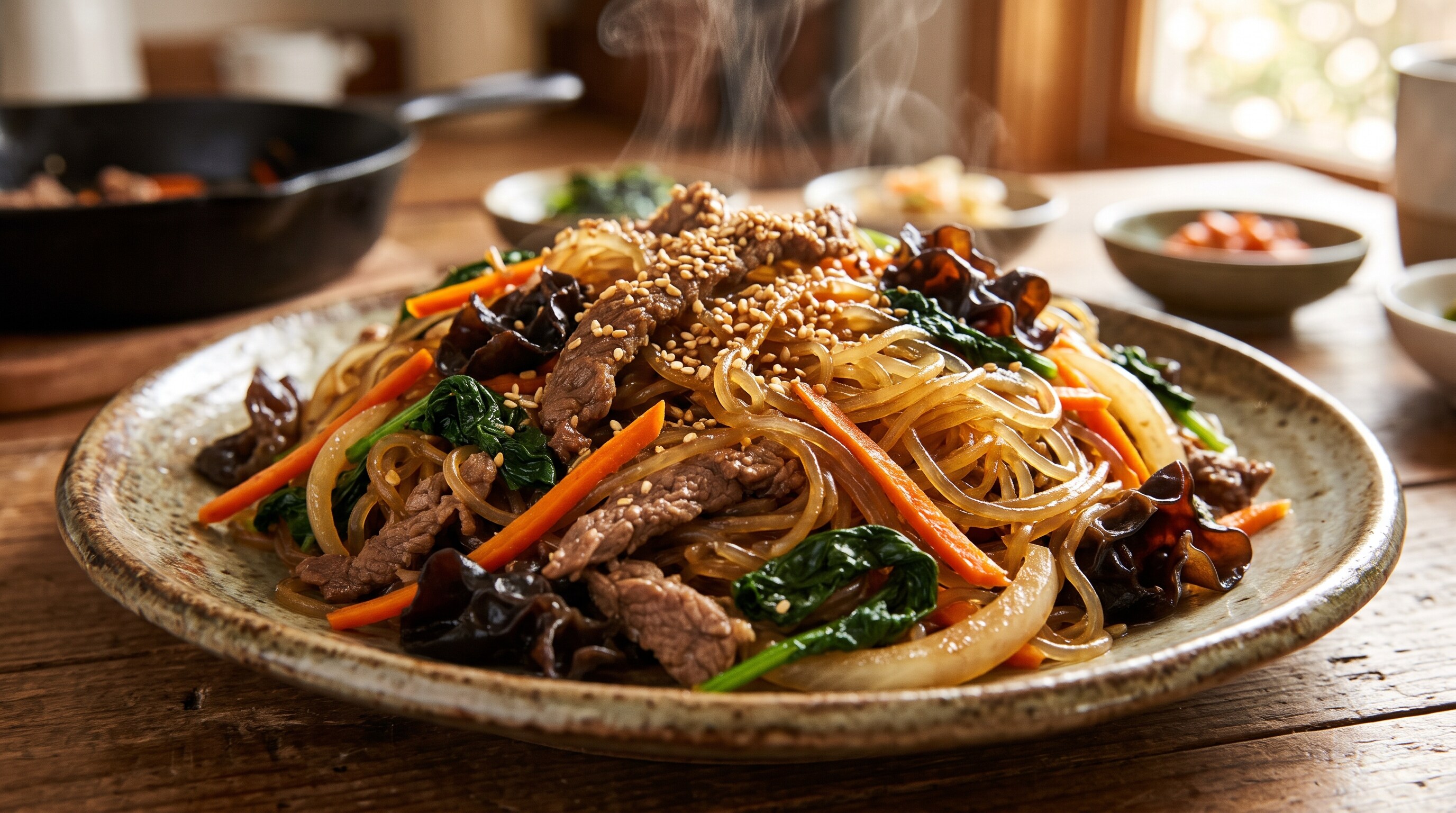
Quick Recipe Snapshot: ⏱️ Prep: 25 mins | 🔥 Cook: 20 mins | 🍽️ Servings: 4–5 | 💡 Key Secret: Pan-glazing hot boiled noodles directly in a simmering soy-sugar reduction locks flavor inside the sweet potato starch matrix, while separate flash-searing keeps every vegetable crisp.
Widely celebrated as the undisputed centerpiece of Korean festive banquets, holiday feasts (Chuseok and Seollal), and birthday celebrations, Japchae (잡채) is a breathtaking harmony of translucent, chewy sweet potato glass noodles (dangmyeon), tender marinated beef strips, and vibrant five-color vegetables. Every forkful offers a luxurious symphony of textures: the delightful elasticity of glossy noodles, crisp-tender ribbons of carrots and onions, earthy chew of shiitake mushrooms, and the rich, nutty fragrance of pure toasted sesame oil.
Historically created in the 17th century for King Gwanghaegun during the Joseon Dynasty, the name Japchae translates literally to “mixed vegetables” (jap meaning mixed, chae meaning vegetables). Today, sweet potato starch noodles form the beloved core of the dish, creating a culinary masterpiece that bridges royal banquet elegance with home-cooked comfort.
Yet, despite its widespread popularity, home cooks frequently encounter three frustrating stumbling blocks: glass noodles that turn gummy, limp, or waterlogged after cooling; noodles that taste bland because the sauce merely slips off their slick surface; or a dull, muddy bowl where soggy vegetables have bled excess water into the dish.
The difference between mediocre cafeteria noodles and high-end restaurant Japchae comes down to three precise food science principles: sweet potato starch gelatinization kinetics, surface glaze caramelization, and independent moisture barrier management.
Follow this guide to master the royal banquet art of traditional Korean Japchae on your home stove.
1. The Culinary Science Behind Chewy, Non-Soggy Japchae
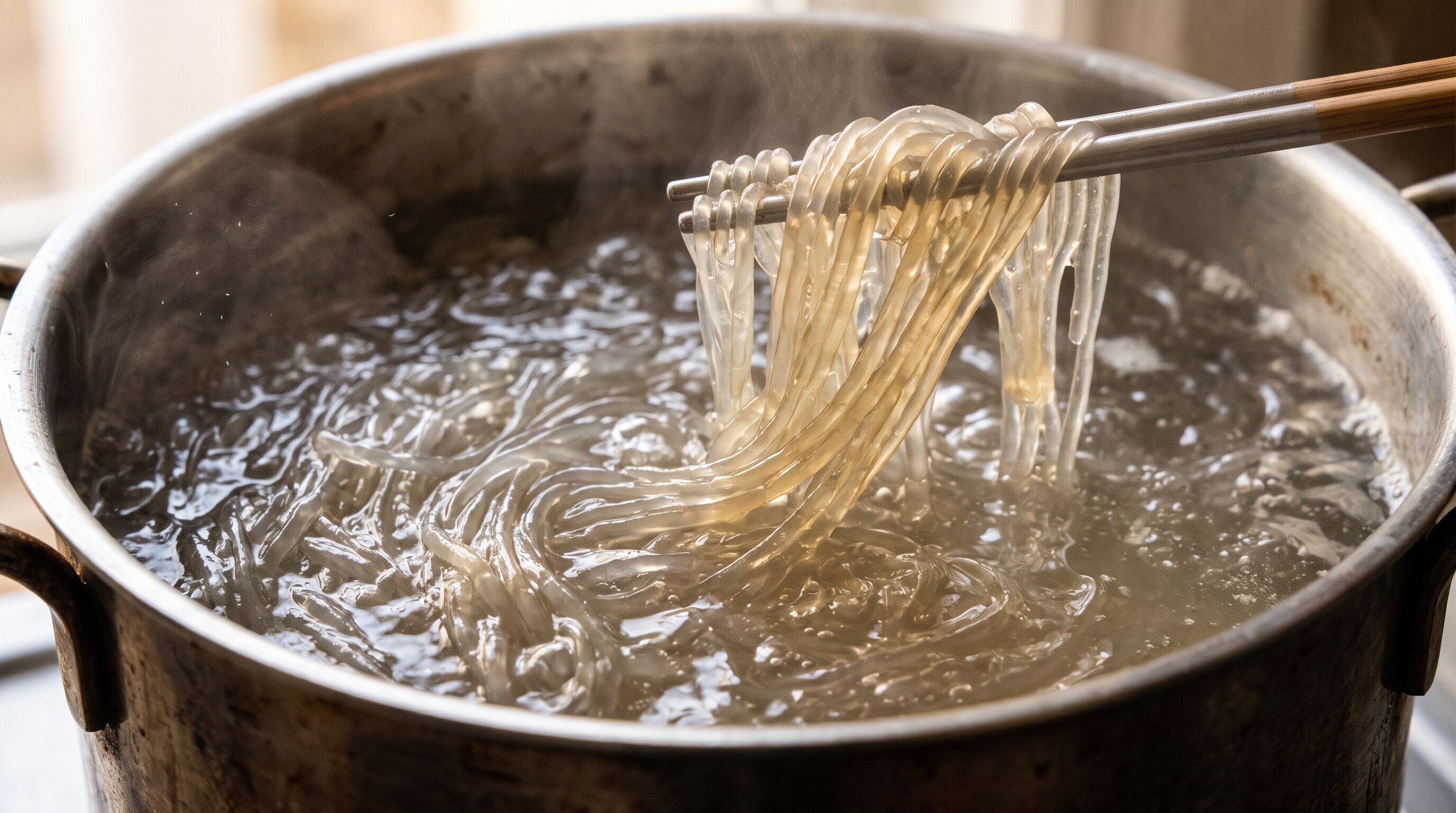
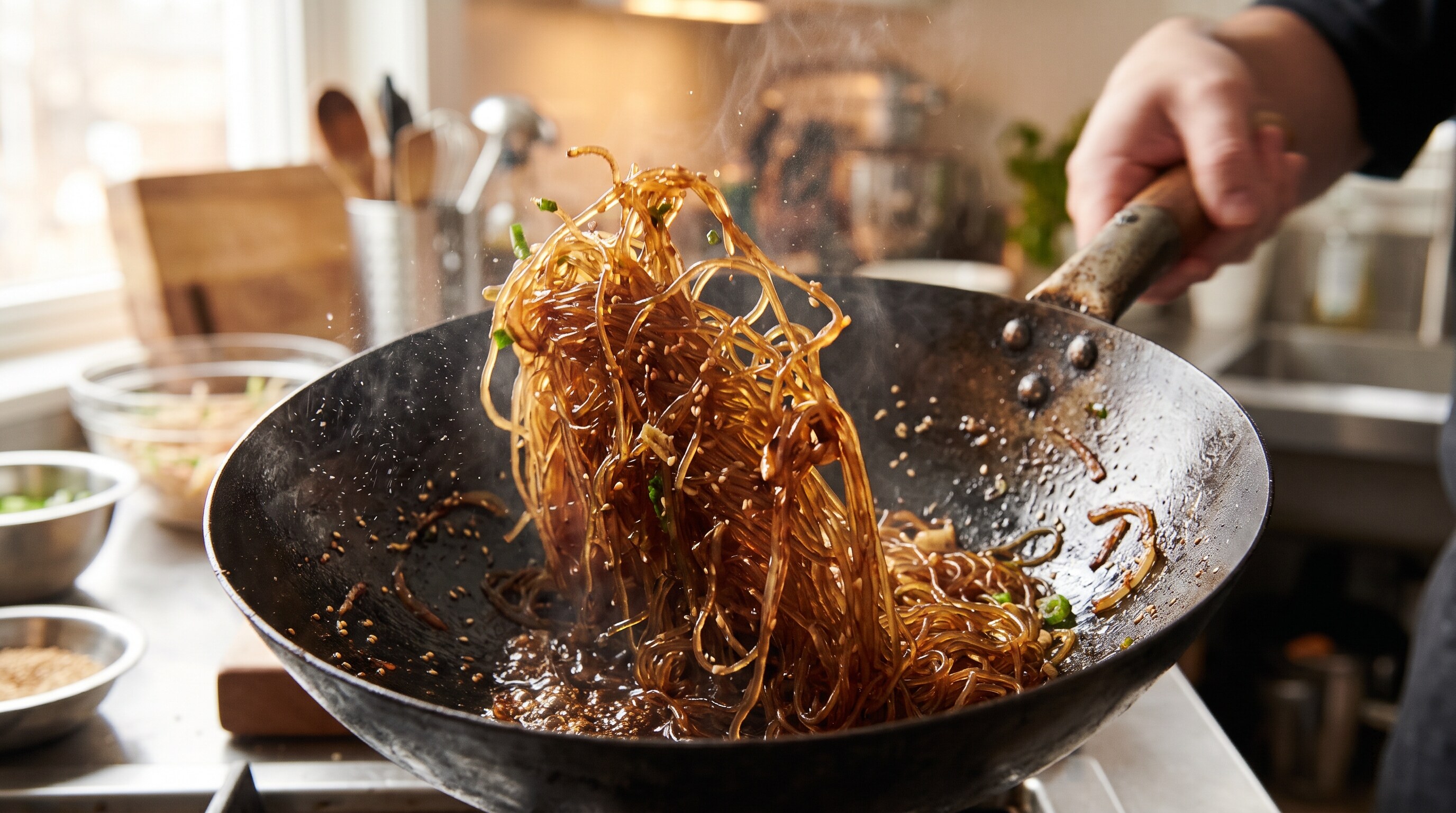
Achieving the coveted jjolgit-jjolgit (bouncy, elastic chew) in Korean glass noodles requires understanding how sweet potato starch behaves under varying thermal conditions.
💡 Culinary Science 1: Sweet Potato Starch Gelatinization & Retrogradation Control Korean glass noodles (dangmyeon) are crafted from 100% pure sweet potato starch, devoid of wheat gluten. Sweet potato starch is rich in high-molecular-weight amylose chains with tight intermolecular bonding. During boiling at 100°C (212°F) for 7 to 8 minutes, the starch granules undergo complete gelatinization—absorbing water, swelling, and transitioning from opaque brittle strands to crystal-clear, bouncy filaments.
However, if you rinse boiled dangmyeon under ice-cold tap water (a technique common with wheat noodles), rapid thermal shock triggers retrogradation, causing starch polymers to expel water (syneresis) and turn stiff or rubbery. Instead, draining the noodles hot and coating them immediately in a simmering soy glaze ensures the starch matrix binds the savory umami deep into its helical molecular structure while hot steam evaporates excess surface moisture.
💡 Culinary Science 2: Separate Ingredient Searing to Prevent Moisture Migration In Korean culinary philosophy, the five cardinal colors (Obangsaek) represent universal harmony: green (spinach), red/orange (carrots), black/brown (wood ear and shiitake mushrooms, beef), and white/yellow (onions). Beyond philosophical beauty, cooking each topping separately is pure biochemical wisdom.
Different vegetables possess drastically varied water contents and cellular breakdown thresholds. Onions release high levels of free water containing sulfur compounds when cellular walls rupture above 65°C (149°F), while carrots require brief searing in dietary fat to dissolve fat-soluble carotenoids without softening hemicellulose fibers. Sautéing each topping individually over high heat (180°C / 350°F) sears surface cells, locks in natural moisture, and prevents water leakage from diluting the noodles later.
2. Essential Ingredients & The Golden Ratio Soy Glaze
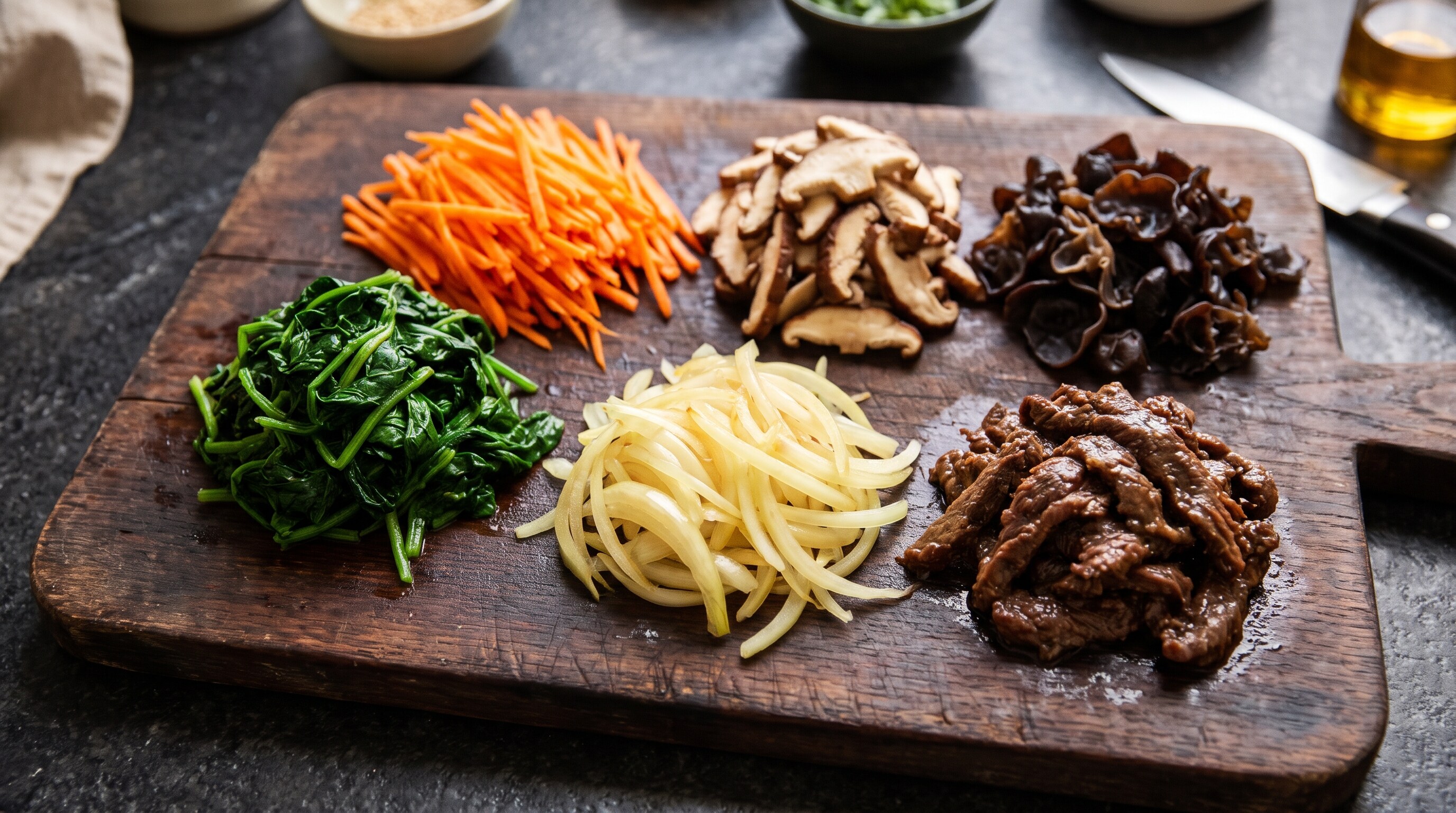
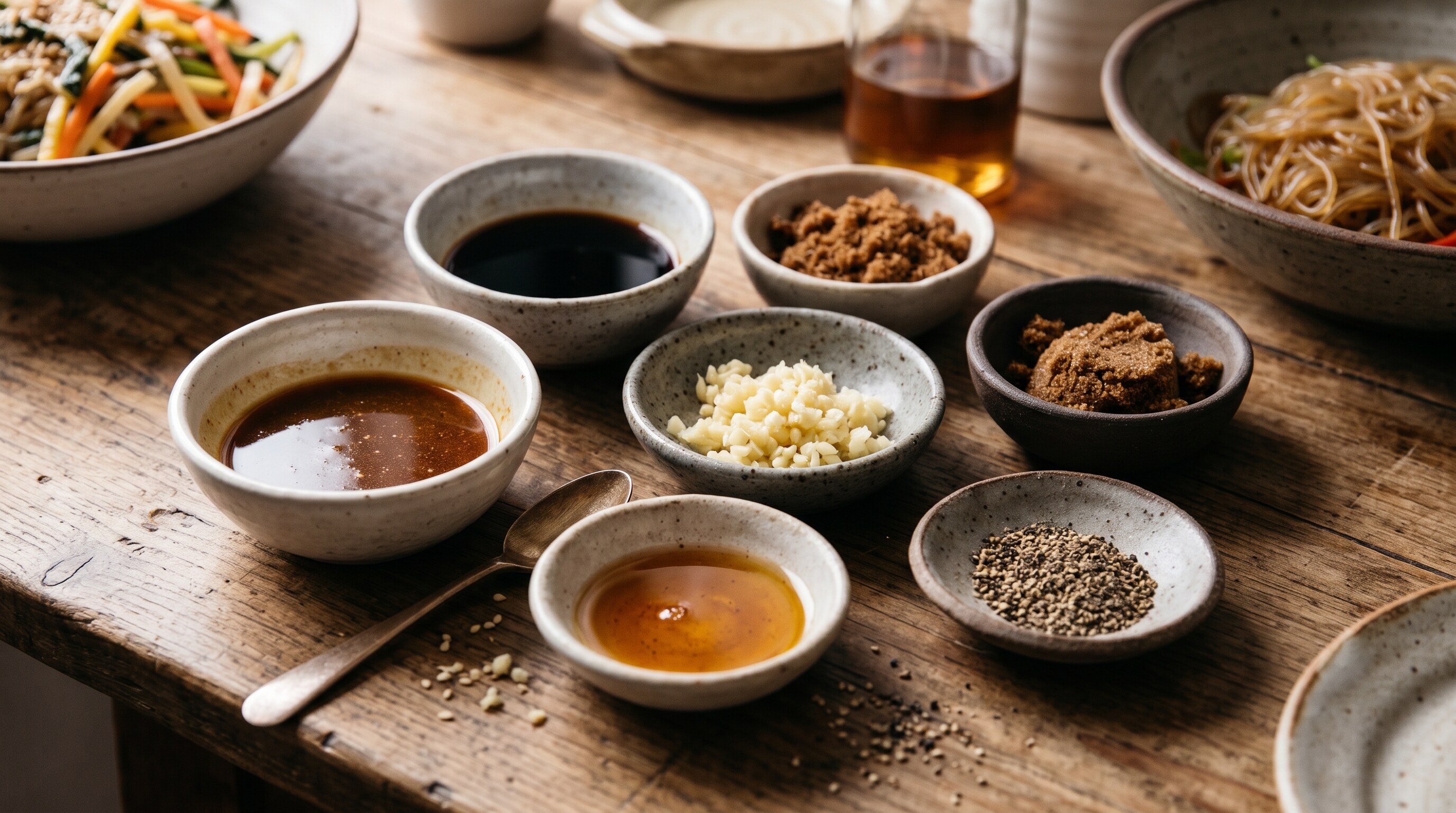
This standard recipe yields 4 to 5 hearty banquet servings. Measurements are calibrated using both standard metric weights and US home kitchen volumetric equivalents.
| Category | Ingredients & Amounts (Metric & US) | Chef’s Notes & Substitutions |
|---|---|---|
| Noodle Foundation | 250g (8.8 oz) Korean sweet potato starch glass noodles (dangmyeon) | Look for “100% Sweet Potato Starch” on the package (Ottogi, CJ, or Wang brands at H-Mart). Avoid mung bean vermicelli, which is too thin and turns mushy. |
| Protein Centerpiece | 150g (5.3 oz) beef sirloin, tenderloin, or flank steak, cut into 5cm (2-inch) matchsticks | Thinly sliced pork loin or chicken breast can be used. For a vegetarian version, substitute with 150g (5.3 oz) pressed firm tofu or king oyster mushrooms. |
| Beef Marinade | 1 tbsp soy sauce (15ml) + 1 tsp brown sugar (4g) + 1 tsp minced garlic (5g) + 1 tsp sesame oil (5ml) + 1/4 tsp black pepper | Pre-marinating beef for 15 minutes seasons the core proteins and tenderizes muscle fibers before high-heat searing. |
| Verdant Greens | 200g (7 oz / 1 large bundle) fresh mature spinach, washed and root trimmed | English or regular curly spinach holds texture far better than delicate baby spinach leaves. |
| Spinach Dressing | 1/2 tsp fine sea salt (2.5g) + 1/2 tsp toasted sesame oil (2.5ml) | Seasoning the blanched, squeezed spinach separately locks in chlorophyll and prevents bland green pockets. |
| Aromatic Vegetables | 1 medium yellow onion (180g / 6.3 oz) + 1 medium carrot (120g / 4.2 oz) + 1 scallion | Slice onions and julienne carrots into uniform 5cm (2-inch) matchsticks matching noodle thickness. |
| Woodland Earthiness | 4 fresh shiitake mushrooms (80g / 2.8 oz) + 10g (0.35 oz) dried wood ear mushrooms (mok-i) | Wood ear mushrooms provide an iconic gelatinous crunch. Dried shiitake can also be reconstituted if fresh ones are unavailable. |
| Golden Soy Glaze | 5 tbsp Korean regular soy sauce (75ml) + 3 tbsp dark brown sugar (36g) + 1 tbsp mirin (15ml) + 2 tbsp toasted sesame oil (30ml) | Simmering this sauce before tossing coats the glass noodles in a glistening, mahogany sheen that never separates. |
| Aromatic Finish | 1 tbsp toasted sesame seeds (10g) + 1/2 tbsp extra toasted sesame oil (7.5ml) | Always add fresh sesame oil at the very final toss to preserve volatile aromatic terpenes from heat breakdown. |
| High-Heat Cooking Fat | 2 tbsp neutral cooking oil (30ml, avocado or canola oil) | Used in small increments (1/2 tsp to 1 tsp per batch) to flash-sear vegetables without creating greasiness. |
3. Step-by-Step Cooking Instructions
Follow these five chronological stages closely. Because each ingredient cooks in just 1 to 3 minutes, preparing your ingredients beforehand (mise en place) guarantees a stress-free cooking experience.
Step 1. Marinate Beef Strips & Rehydrate Wood Ear Mushrooms
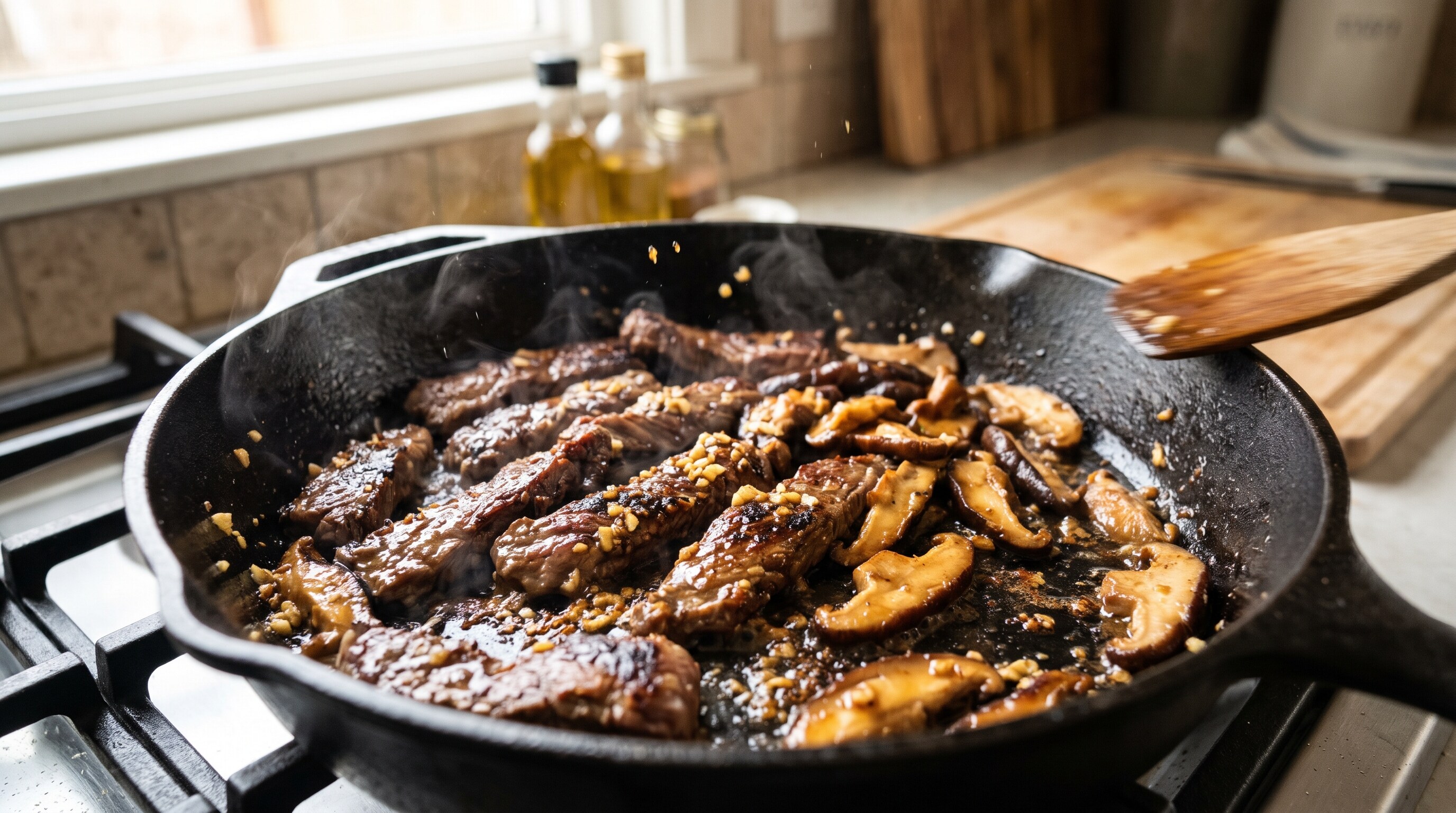
Slice 150g (5.3 oz) of beef across the grain into thin matchsticks approximately 5cm (2 inches) long and 0.5cm (0.2 inches) thick. In a small mixing bowl, combine the beef with 1 tablespoon of soy sauce, 1 teaspoon of dark brown sugar, 1 teaspoon of minced garlic, 1 teaspoon of toasted sesame oil, and 1/4 teaspoon of freshly cracked black pepper. Massage thoroughly with your fingers and let rest for 15 minutes at room temperature.
Meanwhile, place 10g (0.35 oz) of dried wood ear mushrooms in a bowl of warm water (approx. 40°C / 104°F) for 15 minutes. Once plump and expanded to six times their original volume, rinse under cold water to remove any grit, slice away any hard knobby centers at the base, and cut into thin ribbons. Thinly slice the fresh shiitake caps into 0.5cm (0.2-inch) strips.
Step 2. Blanch Spinach & Quick-Shock in Ice Water
Fill a large saucepan with 1.5 liters (6.3 cups) of water and add 1/2 teaspoon of salt. Bring to a rolling boil over high heat. Submerge 200g (7 oz) of trimmed spinach into the bubbling water. Blanch for precisely 30 seconds—just until the leaves wilt and turn bright emerald green.
Immediately scoop the spinach out and plunge it into a prepared bowl of ice-cold water to arrest residual thermal carryover, preserving its vibrant green chlorophyll pigments. Once thoroughly cooled, gather the spinach into your hands and squeeze firmly with both fists to expel as much excess water as humanly possible. Fluff the tight ball of spinach apart, toss with 1/2 teaspoon of fine sea salt and 1/2 teaspoon of toasted sesame oil, and set aside in your large serving mixing bowl.
Step 3. Separately Sauté Aromatics, Vegetables & Beef
Place a wide skillet or wok over medium-high heat (180°C / 350°F) and drizzle 1/2 teaspoon of neutral cooking oil.
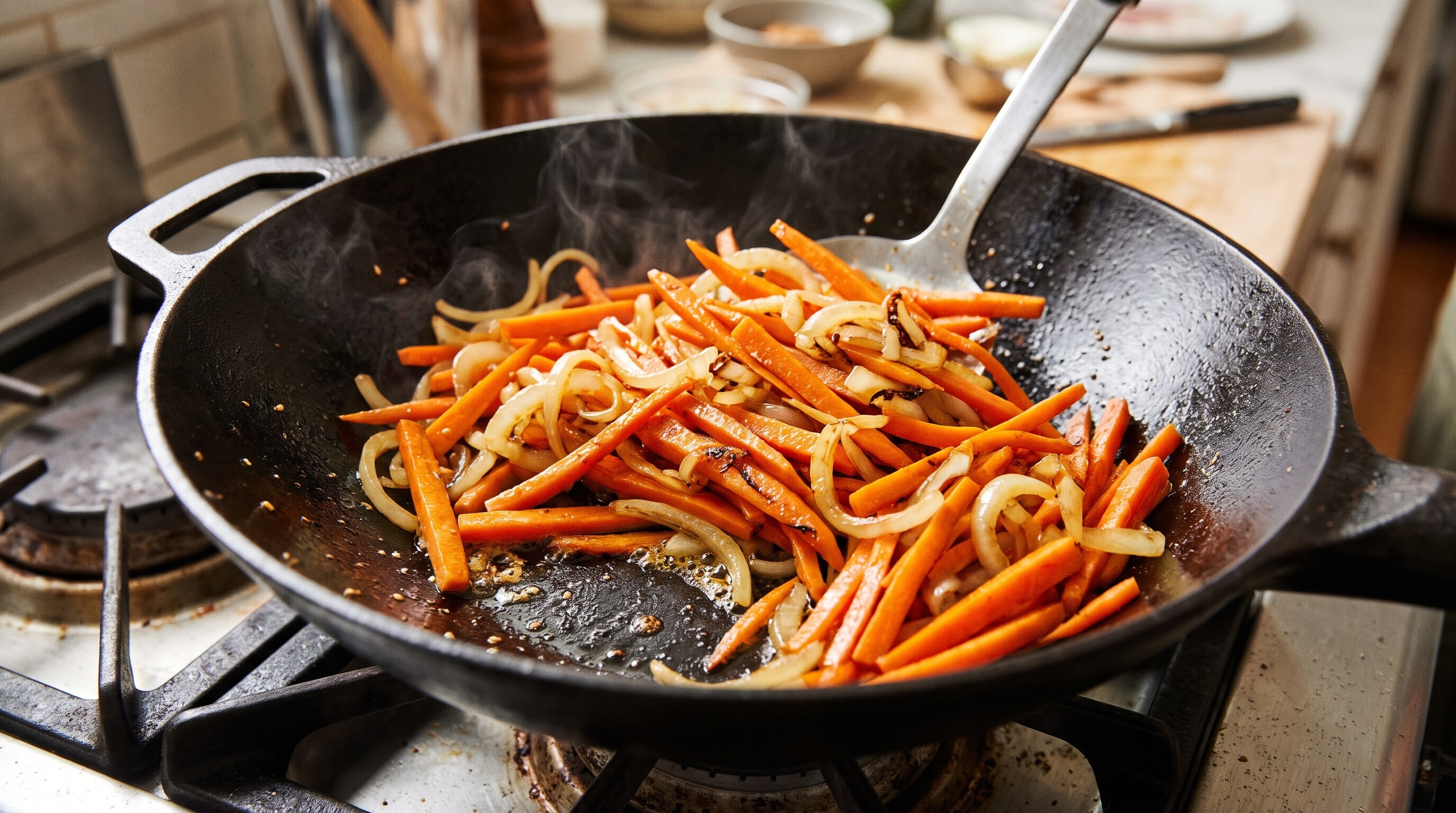
- Onions: Add the sliced yellow onion with a tiny pinch of salt. Stir-fry for 2 minutes until translucent and glossy, but still retaining a subtle crunch. Transfer immediately to the large mixing bowl next to the spinach.
- Carrots: Add another 1/2 teaspoon of oil to the skillet. Sauté the julienned carrots with a pinch of salt over medium-high heat for 2 minutes until pliable and vivid orange. Transfer to the bowl.
- Mushrooms: Add 1/2 teaspoon of oil. Sauté the sliced fresh shiitake and wood ear mushroom ribbons together for 2 minutes until tender and fragrant. Transfer to the bowl.
- Beef & Scallions: Turn heat to high (200°C / 392°F). Add the marinated beef strips and cut scallions. Sear aggressively for 2 to 3 minutes, tossing constantly with chopsticks until the beef is deeply browned, juices have caramelized onto the meat, and no pink remains. Empty the sizzling beef and pan pan-drippings into the bowl with the vegetables.
Step 4. Boil Dangmyeon & Pan-Glaze in Soy-Sesame Reduction
In a large stockpot, bring 2.5 liters (10.5 cups) of water to a vigorous rolling boil. Add 250g (8.8 oz) of dry dangmyeon noodles. Cook uncovered over medium-high heat for 7 to 8 minutes. Test a strand at the 7-minute mark: it should be completely translucent throughout, pliable, and pleasantly chewy with zero hard starchy core.
Pour the noodles into a colander to drain hot water thoroughly. Do not rinse the noodles in cold water. Let them steam in the colander for 1 minute to shed surface moisture.
While the noodles drain, place your wide skillet back on medium heat. Pour in 5 tablespoons of Korean regular soy sauce (jin ganjang), 3 tablespoons of dark brown sugar, 1 tablespoon of mirin, and 2 tablespoons of toasted sesame oil. Bring the mixture to a brisk bubble for 30 seconds until the sugar fully dissolves and the syrup thickens slightly.
Dump the hot, drained noodles directly into the bubbling sauce reduction. Toss and stir-fry continuously with tongs for 2 minutes over medium heat. Watch as the translucent noodles greedily absorb the mahogany glaze, turning glossy, deeply seasoned, and delightfully slippery.
Step 5. Combine, Snip Noodles & Toss Together
Transfer the piping-hot glazed noodles directly into the large bowl holding the prepped beef, spinach, carrots, onions, and mushrooms.
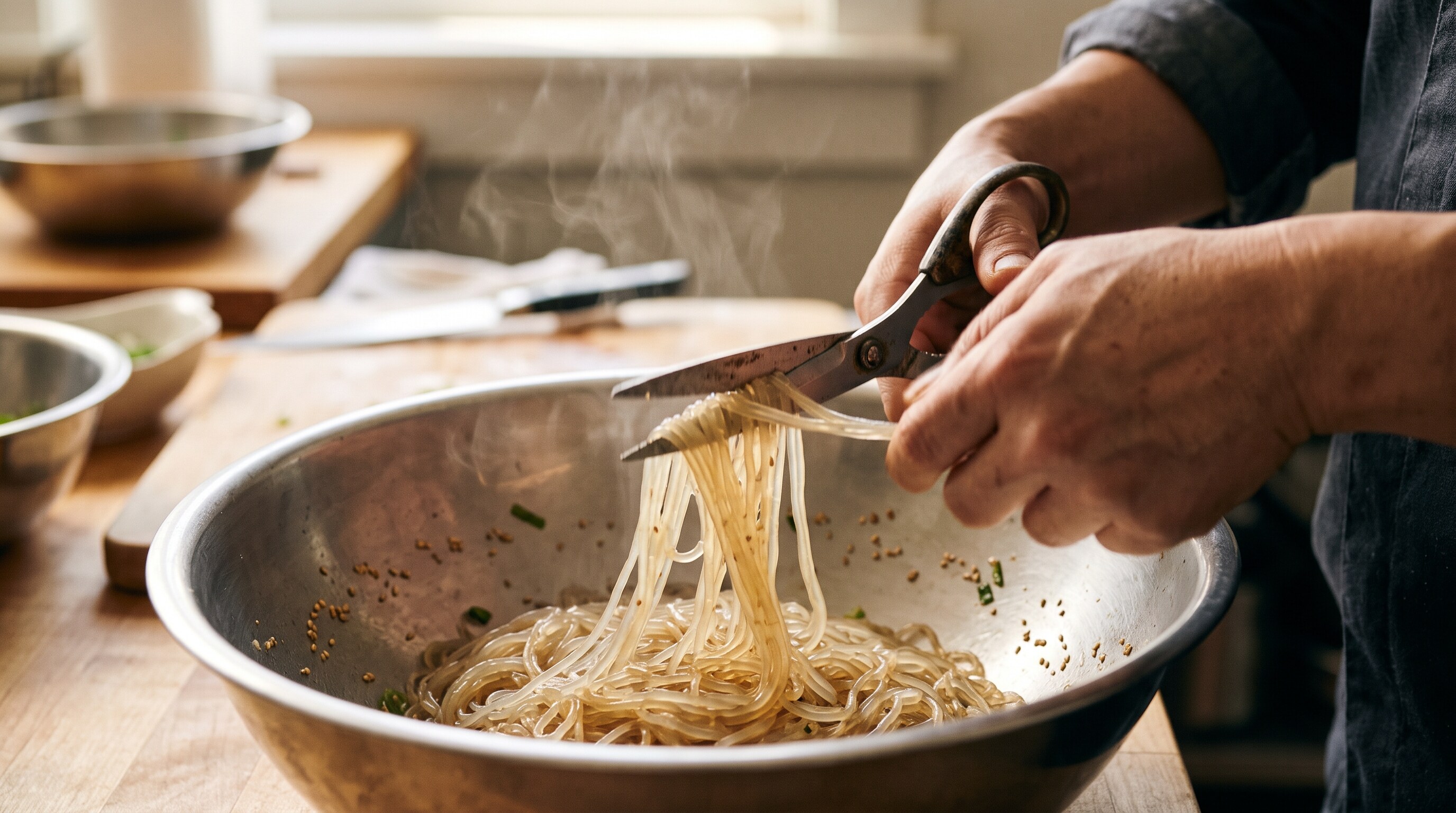
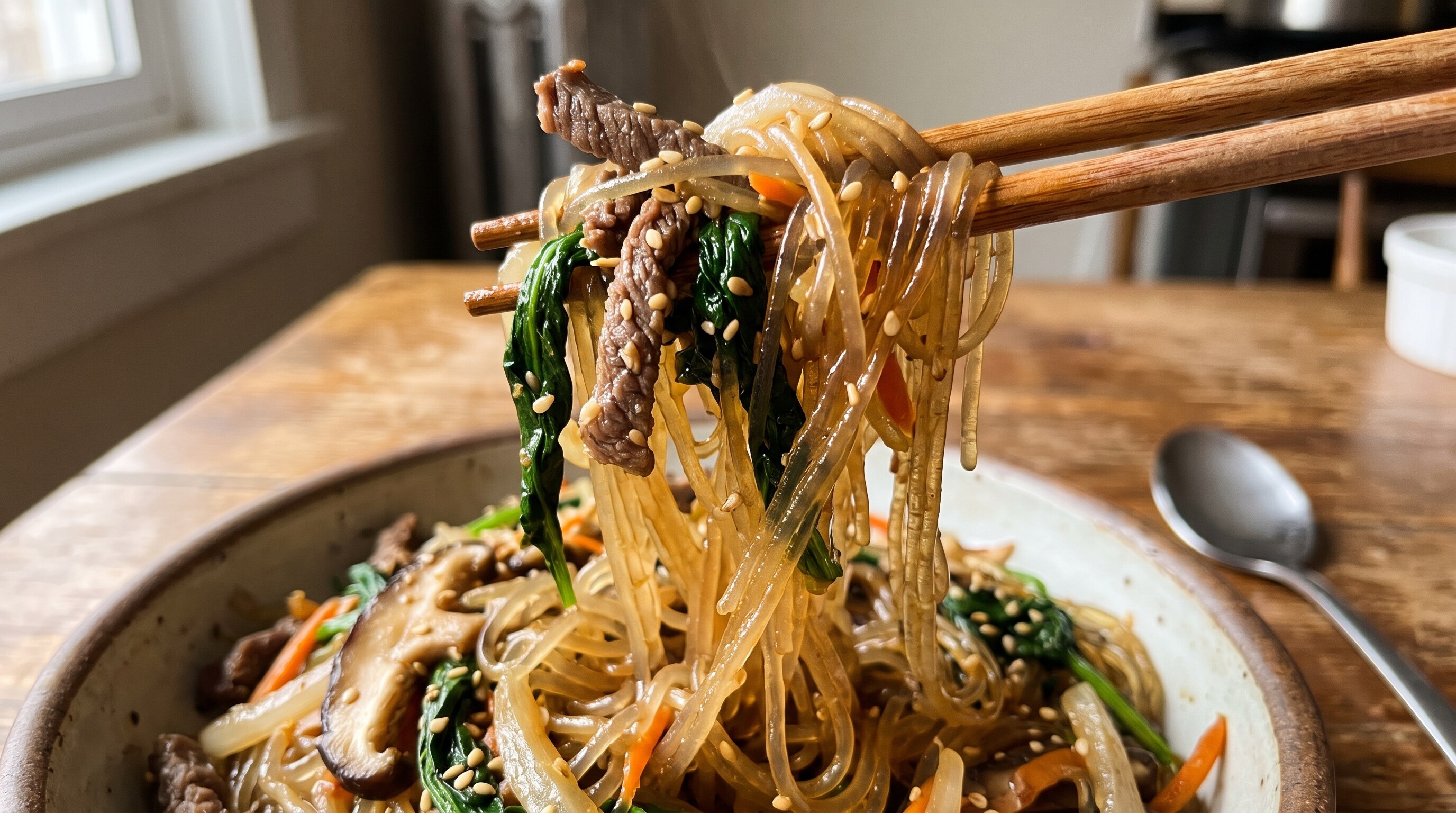
Because sweet potato glass noodles are remarkably long and elastic, use a clean pair of kitchen shears to cut across the noodle bundle 2 or 3 times. This vital step prevents awkward tangles and ensures effortless serving.
Drizzle the remaining 1/2 tablespoon of toasted sesame oil over the mixture and sprinkle 1 tablespoon of toasted sesame seeds. Using tongs or food-safe silicone gloves, gently lift and toss all ingredients from the bottom up until the colorful vegetables and savory beef strips are evenly distributed throughout the glossy noodles. Taste a noodle; if you prefer a deeper savory note, drizzle a few drops of soy sauce. Transfer to a grand serving platter and serve warm or at room temperature.
4. Pro Chef Tips to Elevate Your Dish
Master these four insider culinary secrets to transform good homemade noodles into an unforgettable royal-tier dish:
- The Kitchen Shears Snipping Rule: Uncut Korean dangmyeon strands can measure over 40cm (16 inches) long. If left uncut, grabbing a portion with chopsticks drags half the bowl’s noodles with it, leaving the heavy vegetables behind at the bottom. Two quick perpendicular cuts with kitchen shears after boiling creates the perfect bite-sized balance of noodle and topping.
- The Pan-Reduction Method Over Raw Toss: Many novice recipes suggest tossing boiled noodles with cold soy sauce and sugar in a bowl. Cold seasonings sit merely on the slippery surface and slide off onto the plate. Stir-frying hot noodles in a bubbling sauce reduction expands the starch pores, driving the savory soy and toasted sesame lipids deep into the noodle’s core for lasting flavor.
- Dry-Skillet Pan-Frying for Next-Day Leftovers: If refrigerated, sweet potato starch undergoes temporary retrogradation, turning opaque, pale, and stiff. Never microwave Japchae in a sealed plastic container, which turns it gummy. Instead, heat a wide, dry non-stick skillet over medium heat, add the cold Japchae with 1 teaspoon of water, and toss for 2 to 3 minutes. The direct contact heat melts retrograded amylose bonds and re-caramelizes the soy glaze, returning the noodles to freshly cooked, bouncy perfection.
- The Delicate Egg Ribbon Garnish (Jidan): For genuine royal court presentation, separate an egg into yolk and white, whisk each with a pinch of salt, fry paper-thin sheets in a lightly oiled pan over low heat (120°C / 250°F), roll them up, and slice into matchsticks. Scattering bright yellow egg ribbons on top adds spectacular visual elegance and silky richness.
5. Frequently Asked Questions (FAQ)
Q1. Can I make Japchae vegetarian or vegan-friendly?
Absolutely! Japchae is naturally customizable. Simply replace the beef with extra sliced king oyster mushrooms, portobello mushrooms, or pan-seared firm tofu strips. Ensure you use vegetarian-friendly soy sauce and all other ingredients remain naturally plant-based.
Q2. Why do my Japchae noodles get soggy, clump together, or taste bland the next day?
Bland or soggy Japchae happens when boiled noodles are rinsed in cold water and mixed cold, which prevents sauce absorption. Pan-reducing the hot noodles directly in the soy-sugar glaze allows the starch matrix to trap seasoning inside. To reheat leftovers, stir-fry them in a dry non-stick skillet over medium heat for 2-3 minutes with a teaspoon of water—the heat reactivates the gelatinized sweet potato starch to restore its original chewy bounce.
Q3. Can I cook all the vegetables together in one pan to save time?
While tempting, stir-frying all vegetables together releases excess steam and moisture, causing carrots and onions to turn mushy and dulling the vibrant green chlorophyll in spinach. Sautéing each vegetable separately for 90-120 seconds preserves distinct textures, bright colors, and individual aromatic profiles.
6. Serving Suggestions & Korean Table Pairings
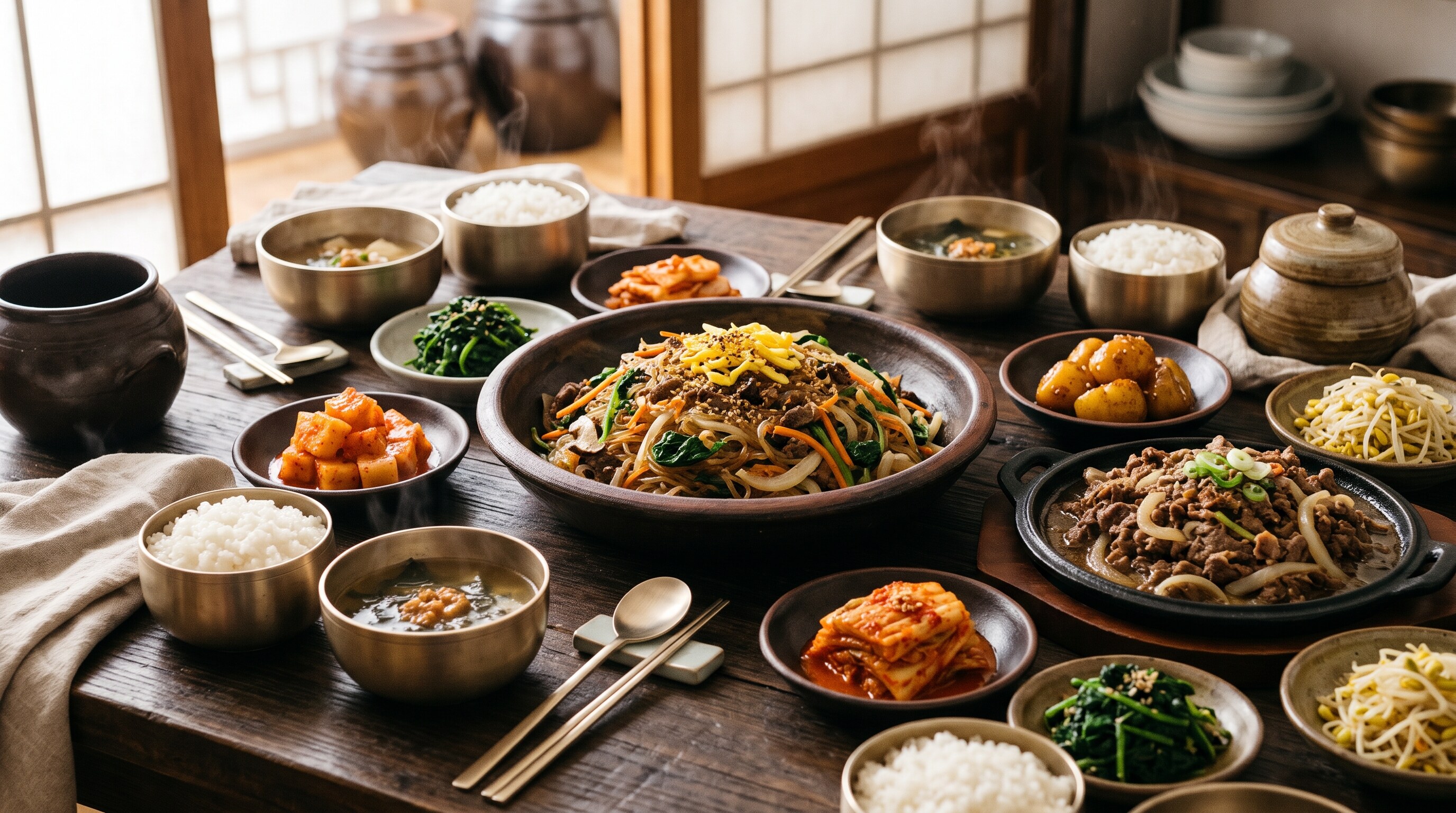
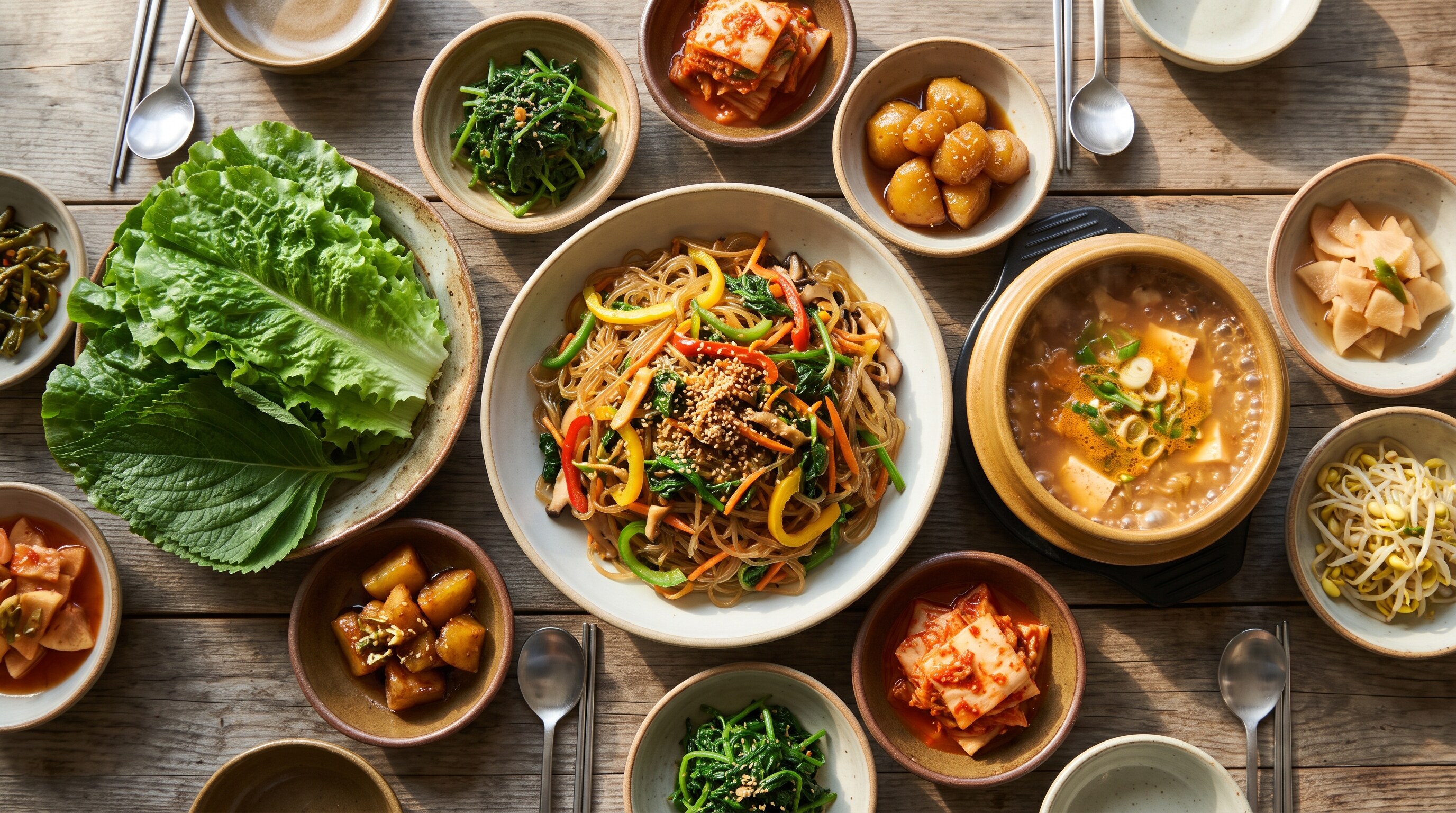
Japchae is famously versatile: it shines equally as a luxurious standalone lunch, a festive party appetizer, or an extravagant side dish (banchan) on a full Korean banquet table. For a popular Korean street-food treat known as Japchae Bap, ladle warm Japchae over a bowl of steamed white short-grain rice with a spoonful of black bean sauce or a fried egg on top.
To build an unforgettable Korean feast, pair this savory-sweet noodle masterpiece with our bold, protein-packed classics:
- Serve alongside the sizzling sweetness of Tender Korean Beef Bulgogi for the ultimate classic K-BBQ feast.
- Balance the rich sesame noodles with the vibrant, spicy kick of Rich Pork Belly Kimchi Jjigae or hearty Traditional Korean Beef Brisket Doenjang Jjigae.
- For party crowds, contrast the silky noodles with the shattering crunch of Extra-Crispy Korean Fried Chicken.
- Love Korean chicken dishes with glass noodles? Don’t miss our braised classic Andong Jjimdak (Korean Braised Chicken with Glass Noodles).